Congratulations — if you’re reading this curriculum roadmap, you’ve likely completed the AI Essentials Curriculum, our 7-step foundation series. The foundation series introduces tokens, tool selection, prompt structure, and verification habits. This Level 2 curriculum builds on those skills without assuming mastery. You are, in the words of our finale, a capable, responsible driver.
So what’s next? This.
💡 Level 1 curriculum roadmap taught you to drive the car. Level 2 teaches you to build the garage: custom assistants that know your business, supervised automations that handle selected steps, images and video made to your spec, and your first real AI-built tool.
The destination isn’t “better answers” anymore — it’s reusable systems and assets with your name on them.
Who this is for: Essentials graduates and anyone comfortable with the basics — creators, office workers, solo founders, side-hustlers, students, and teachers. Still no math degree, and (spoiler for Step 7) still no computer science degree either.
Prerequisite: Completing AI Essentials Steps 1–7 first is recommended. Level 2 builds directly on those concepts — especially prompting (Step 6), tool selection (Step 5), and verification habits (Step 7).
💡 How to use this guide: Click each step below to read its deep-dive lesson as it’s published. Following the sequence from Step 1 to Step 8 is recommended — each lesson’s project becomes raw material for the next, and everything converges in the Step 8 capstone.
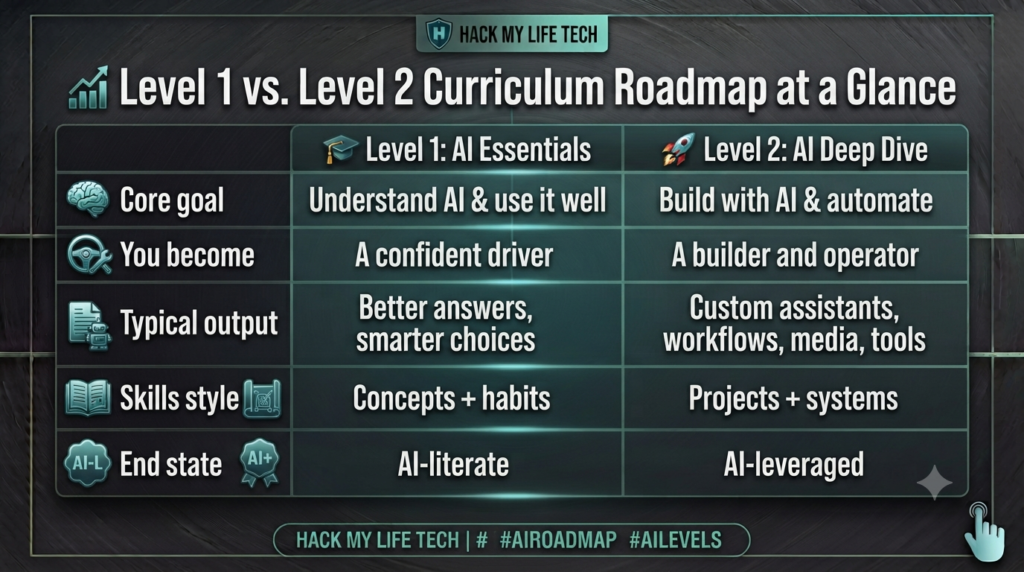
Image note: Visual created with AI assistance using ChatGPT (OpenAI). Original design, editing, and final creative direction by Life Tech Hack.
🟢 Phase 1: Power-User Foundations (Steps 1–3)
- [Deep Dive] Step 1 Advanced Prompting & Context Engineering: From Formulas to Systems
- Deep Dive curriculum roadmap : Level 1’s R-C-T-F-E formula was one great prompt. Now we build prompt systems: standing custom instructions that shape every conversation, prompt chaining (one output becomes the next input in a pipeline), meta-prompting (having the AI improve your prompt before running it), and the bigger idea the industry now calls context engineering — realizing that what you show the model matters more than the magic words you use.
- What You’ll Gain: Consistency. Instead of re-explaining yourself in every chat, you’ll operate reusable systems that create a more consistent starting point from one task to the next, while still requiring review.
- How to Apply It: Turn any recurring task — the weekly report, the content pipeline, the client update — into a saved 2–3 step chain you run in minutes.
- [Deep Dive] Step 2 Feed the Machine: Your Files, Your Data & RAG (No Traditional Programming Needed)
- Deep Dive curriculum roadmap: Grounding an AI system in relevant documents can make answers more useful for document-based tasks, but it does not guarantee accuracy. We’ll cover file uploads, persistent knowledge bases such as Claude Projects, custom GPT knowledge, and Gemini’s notebook-style tools. We’ll also demystify RAG (Retrieval-Augmented Generation) with an open-book-exam analogy: retrieval means giving the model relevant pages before it answers. The system may still retrieve the wrong passage, misunderstand the source, or omit important information, so verification remains necessary.
- What You’ll Gain: An AI workflow that can use your manuals, notes, and policies as source material, while still requiring verification when accuracy matters.
- How to Apply It: Build a personal knowledge base (“chat with my stuff”): public or approved non-sensitive product documentation, study materials, and reference files — searchable by conversation.
- [Deep Dive] Step 3 Build Your Own AI Assistant: Custom GPTs, Claude Projects & Gemini Gems
- Deep Dive curriculum roadmap: ChatGPT GPTs, Claude Projects, and Gemini Gems can help users create more consistent specialist workflows without traditional programming. However, available features, sharing options, file limits, and eligibility requirements differ across platforms and plans. In practice, you provide standing instructions, attach relevant knowledge files from Step 2, and test the assistant repeatedly until it performs one clearly defined job reliably.
- What You’ll Gain: A reusable assistant that follows your standing instructions more consistently, while still requiring testing and human review — the compounding version of everything you learned about prompting.
- How to Apply It: A listing-writer bot for your resale hustle, a tutor built on your exact syllabus, a brand-voice writer for your blog, a meeting-notes formatter for your team.
- Note: Builder features and names change quickly across platforms. Each lesson time-stamps its walkthroughs and points you to official docs for the latest.
🟡 Phase 2: The Creation Studio (Steps 4–5)
- [Deep Dive] Step 4 AI Image Generation: Prompt Like an Art Director
- Deep Dive: Image models are a different species from the LLMs you know — we’ll cover the concept (diffusion: sculpting an image out of noise) just deep enough to prompt them well. Then the craft: the image-prompt formula (subject, style, composition, lighting, medium), iterating with reference images, and keeping characters and branding consistent across generations. We’ll close with the part most tutorials skip: commercial-use rights and copyright basics, continuing the ethics thread from Essentials Step 7.
- What You’ll Gain: The ability to guide image-generation tools more deliberately, turning a visual idea into a series of usable drafts, without design school.
- How to Apply It: Blog featured images, video thumbnails, product mockups, social graphics — an on-brand visual pipeline that can reduce production time and may begin with free or low-cost tools, depending on the platform and usage level.
- [Deep Dive] Step 5 AI Video & Voice: From Script to Screen Without a Studio
- Deep Dive: The frontier of generative AI: text-to-video tools, AI voiceover and narration, and the realistic one-person pipeline — script (LLM) → visuals (Step 4 skills) → voice → assembly. Equal parts capability and honesty: what today’s video models genuinely do well (short, supervised clips), where they fail, and the disclosure ethics of synthetic voices and faces.
- What You’ll Gain: A one-person media studio workflow — and calibrated expectations that keep you productive instead of frustrated.
- How to Apply It: Shorts and reels for your channel, tutorial videos, podcast trailers, ad drafts to test ideas cheaply.
- Note: This is the fastest-moving area in all of AI. Lessons carry “as of” dates; always verify current tools before subscribing.
🔴 Phase 3: Automation, Building & Earning (Steps 6–8)
- [Deep Dive] Step 6 AI Agents & Automation: Delegate Whole Workflows, Safely
- Deep Dive: The 2026 frontier. A chatbot answers; an agent pursues a goal — planning steps, using tools (your browser, your files, your apps), and working across many actions. We’ll survey the big three’s agent offerings, connect AI to your everyday apps through automation platforms, and — most importantly — build the supervision habit: human checkpoints, limited permissions, and budgets, because Essentials Step 7’s accountability rule (“you sign the work”) matters more when the AI acts instead of just talks.
- What You’ll Gain: Judgment about what to delegate and what to keep manual — plus your first safe, working automation.
- How to Apply It: Inbox triage that drafts replies for your review, research-and-summarize pipelines, data entry with a human approval step.
- [Deep Dive] Step 7 Vibe Coding: Build Your First Real Tool with AI
- Deep Dive: The wall between “user” and “builder” has fallen. You’ll describe a tool in plain language, watch AI write the code, and iterate by conversation — no CS degree required. We’ll cover the modern no-code/AI-assisted building surfaces, how to steer code you can’t fully read, sensible project scope (personal calculators, trackers, mini-sites, internal tools), and the security common sense that comes with it: don’t ship what you can’t inspect if it touches other people’s data.
- What You’ll Gain: A shipped, working tool you made — and the identity shift that comes with it.
- How to Apply It: A custom calculator for your niche, a habit tracker, a landing page for your side hustle, a small internal tool that saves your team an hour a week.
- [Deep Dive] Step 8 Capstone — Your Personal AI Stack & Turning Skills into Income
- Deep Dive: Everything converges. You’ll document your personal AI stack — the tools, assistants, chains, and automations from Steps 1–7 — into a portfolio artifact. Then, the honest money conversation: the four realistic lanes (doing your existing work faster and better, freelancing AI-augmented services, building digital products, and creating content), how to price and disclose ethically, and a sustainable system for staying current — release notes, and the quarterly personal bake-off you learned in Essentials Step 5.
- What You’ll Gain: A documented, demonstrable capability set — and a first-30-days plan for one income lane, minus the get-rich-quick fantasy.
- How to Apply It: Develop and test one small, clearly scoped asset over a month: a service offer, a digital product, a content series, or simply the strongest performance review of your career.
🙋 Quick FAQ Before You Begin
“Do I need to know how to code?” No. Steps 1–6 are designed to be approachable without traditional programming. However, some projects may still require account setup, file organisation, permissions, API keys, or light technical configuration. And Step 7 (vibe coding) is precisely about building without traditional coding skills — the AI writes; you describe, test, and steer. If you finished Essentials, you have the intended foundation; test each workflow with low-risk material and seek qualified review when a project affects other people, money, security, or regulated decisions.
“How long will this take?” Each step is designed as one to two focused weekends of reading plus hands-on practice. The full curriculum may take roughly two to three months, depending on your pace, prior experience, and available practice time. Each step is intended to produce a practical artifact, but results will vary by project and tool.
“Do I need paid subscriptions?” Some providers offer a limited free or low-cost starting path. Platform features, usage limits, privacy settings, and builder permissions vary, but platform features, usage limits, and builder permissions vary by account, plan, region, and date. Check the official documentation before choosing a tool or subscribing, and the lesson identifies where a paid feature may reduce friction, subject to the provider’s current terms. Revisit the subscription math from Essentials Step 5: upgrade only the tool that becomes your bottleneck — Level 2 will make it obvious which one that is.
🚀 Ready to Go Deeper?
Same advice as Level 1, doubled: don’t binge this in one evening. Each step’s project feeds the next, so build as you go — the compounding is the point.
Bookmark this page and return whenever you’re ready for the next step. Level 1 made AI make sense. Level 2 makes it work for you — while you’re doing something else.
👉 Available lessons
- Deep Dive Step 1: Advanced Prompting & Context Engineering
- Deep Dive Step 2: Feed the Machine: Your Files, Your Data & RAG
- Deep Dive Step 3: Build Your Own AI Assistant
- Deep Dive Step 4: AI Image Generation: Prompt Like an Art Director
- Deep Dive Step 5: AI Video & Voice: From Script to Screen
- Deep Dive Step 6: AI Agents & Automation
- Deep Dive Step 7: Vibe Coding: Build Your First Real Tool with AI
- Deep Dive Step 8: Capstone — Your Personal AI Stack & Income
⏮️ New here? Start with Level 1: The AI Essentials Curriculum Roadmap
Accuracy, privacy, and scope
This roadmap is educational. Product names, plan limits, and legal obligations change. Use public or approved non-sensitive material for exercises, verify important outputs against primary sources, and obtain qualified advice for legal, financial, medical, security, employment, or regulated decisions.