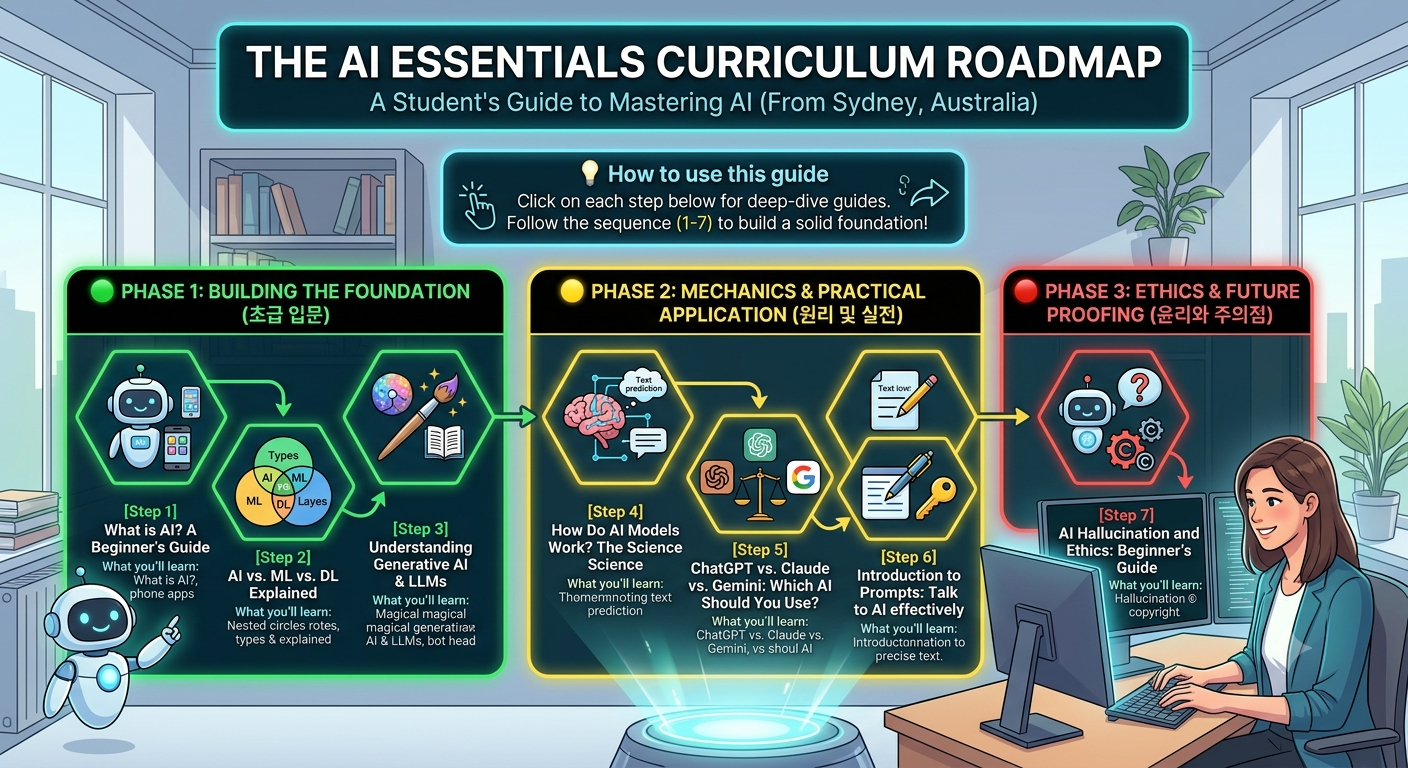
💡 How to use this guide: Click on each step below to read the deep-dive guide for that topic. We highly recommend following the sequence from Step 1 to Step 7 to build a rock-solid foundation!
🟢 Phase 1: Building the Foundation
[Step 1] What is AI? A Beginner’s Guide to Artificial Intelligence
Deep Dive: We’ll explore AI through the lens of “machines that can judge, predict, and create like humans.” We’ll get a sense of how AI works behind the scenes in everyday examples such as Netflix recommendations, spam filters, navigation apps, automatic face sorting in photo apps, etc. The key is to demystify the common misconception that “AI = robots.”
Key Takeaways: You’ll clear up any vague fears or illusions you may have about the word “AI” and become comfortable with it; “Oh, I’ve actually been using this every day.” You will learn the basic vocabulary to understand all the concepts that will follow.
How to Apply It: You’ll be able to tell what “AI-powered” really means when you see it in the news or ads and use the recommendation and automation features of the apps you already use more purposefully.
[Step 2] AI vs. Machine Learning vs. Deep Learning Explained
Deep Dive: Imagine the three concepts as Russian nesting dolls (matryoshka). AI (the broadest concept) covers machine learning (machines learning rules from data on their own). Deep learning is a specific method within that, which emulates the neural networks of the human brain. Learn the hierarchy as a visual diagram, not formulas. Notice the fundamental difference between “rules that humans write by hand” and “rules that machines discover by looking at data.”
Key Takeaways: You’ll learn how to accurately identify buzzwords that are often overused in marketing. If someone says, “This is deep learning,” you can verify for yourself why it really is.
How to Apply It: You can spot the real tech descriptions when you shop for products or services. You can join data conversations with confidence at work.
[Step 3] Understanding Generative AI and Large Language Models (LLMs)
Deep Dive: Learn the difference between ‘discriminative AI’ (classifying whether it’s a cat or a dog) and ‘generative AI’ (creating new text or images). Get an intuitive understanding of how LLMs learn from huge amounts of text to predict the ‘next word’ and grasp the fundamental reason why tools like ChatGPT and Claude are so strong at creation, summarization, and translation.
Key Takeaways: You’ll understand the essence of why generative AI is such a big deal and develop a mindset to see this technology as a tool for content creators and planners.
How to Apply It: You can immediately use generative AI as a practical tool for drafting blog posts, organizing emails, brainstorming ideas, and more.
🟡 Phase 2: Mechanics & Practical Application
[Step 4] How Do AI Models Work? The Science Behind the Answers
Deep Dive: Covers the key question, “Does AI really think, or does it just piece words together probabilistically?” You’ll learn how AI responses are generated through token (word piece) prediction and probability-based selection. This understanding lays the foundation for the next step on hallucinations.
What learners get: You’ll recognize AI not as an ‘all-knowing being,’ but as a ‘smart prediction machine.’ This perspective is the key mindset for using AI wisely.
How to Apply It: You’ll have criteria for judging when AI answers need verification instead of trusting them blindly. It helps manage risk when using AI for important documents or decisions.
[Step 5] ChatGPT vs. Claude vs. Gemini: Which AI Should You Use?
What to study in depth: Compare the tools through the same real, non-sensitive tasks. Features, limits, models, integrations, and pricing change frequently, so verify current capabilities on each provider’s official product and pricing pages before choosing.
What learners get: You’ll develop the insight to pick the right tool for your goals and gain strategic thinking for combining multiple tools depending on the situation.
Practical application: By choosing the optimal AI for each task — writing, coding, research, etc. — you can maximize productivity and reduce wasteful paid subscriptions.
Note: AI tools update very quickly. When teaching this step, make it clear that the comparisons are “as of a specific point in time,” and guide learners to check the latest info on each official site.
[Step 6] Introduction to Prompts: How to Talk to AI Effectively
Deep dive: Learn the basic formula of prompt engineering—Role, Context, Task, Format, Examples. Experience firsthand how vague versus specific questions can drastically change the quality of results.
What learners get: Practical skills to get much better results from the same AI than most people. This is one of the most immediately noticeable abilities in this curriculum.
Practical use: You’ll be able to use AI as a ‘capable assistant’ in almost any personal or work situation—writing reports, organizing study material, planning trips, polishing resumes, and more.
🔴 Phase 3: Ethics & Future Proofing
[Step 7] AI Hallucination and Ethics: What Every Beginner Must Know
What to study in depth: Understand the causes of AI ‘hallucinations,’ where it generates believable but false information (linked to the probabilistic prediction principles from Step 4). On top of that, learn the ethical boundaries every AI user should know, like copyright issues, personal data and bias, and safety guidelines.
What learners practise: Treat AI as a useful but fallible tool, verify consequential claims independently, protect sensitive information, and recognise when human judgment is required.
Real-life application: Before using AI-generated content as is, you’ll get into the habit of verifying facts and sources, preventing mistakes related to copyright or personal data. When using AI for work or creative tasks, you’ll be able to manage legal and ethical risks on your own.
📚 Sources & Further Reading
The individual lessons provide more detailed sources for their specific claims. These primary and official references provide useful background for the curriculum’s central ideas:
- National Institute of Standards and Technology (NIST): Artificial Intelligence — background on AI and trustworthy development.
- NIST AI RMF: Generative AI Profile — risks and responsible-use considerations for generative AI.
- Vaswani et al. (2017), “Attention Is All You Need” — the research paper introducing the Transformer architecture used by modern language models.
- OECD AI Principles — internationally recognised principles for responsible and trustworthy AI.
🚀 Ready to Start Your Journey?
Avoid trying to learn everything in one evening. A practical approach is to complete one lesson at a time, test it with public or non-sensitive material, and record what worked, what failed, and what still needs verification.
Save this page to your bookmarks and return to it whenever you’re ready to take the next step. Together, let’s harness the power of AI to simplify your daily tasks and grow your side businesses.
👉 Click the link below to begin your first lesson:
- Go to Step 1: What is AI? A Beginner’s Guide to Artificial Intelligence
- Go to Step 2: AI vs. Machine Learning vs. Deep Learning Explained
- Go to Step 3: Understanding Generative AI and Large Language Models (LLMs) Explained
- Go to Step 4: How Do AI Models Work? The Science Behind the Answers
- Go to Step 5: ChatGPT vs. Claude vs. Gemini: Which AI Should You Use?
- Go to Step 6: Introduction to Prompts: How to Talk to AI Effectively
- Go to Step 7: AI Hallucination and Ethics: What Every Beginner Must Know