
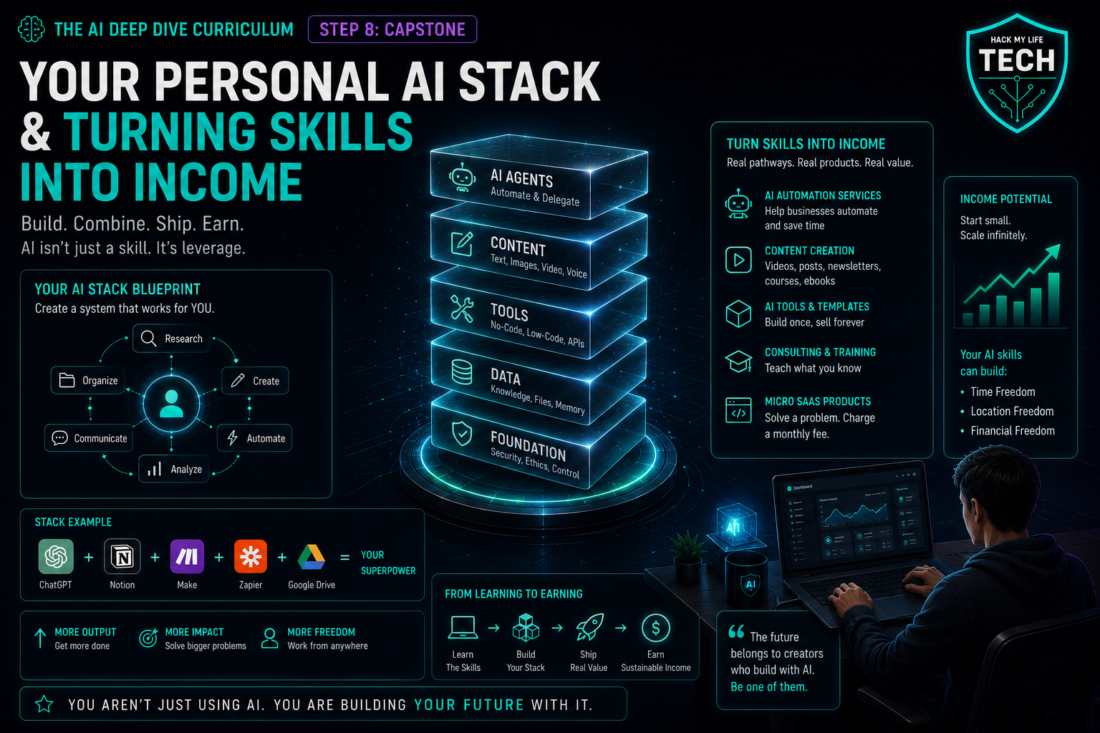
Welcome to the final lesson of the AI Deep Dive. Seven lessons ago you knew how to use AI. Now you engineer personal AI including context, ground models in your own data, build assistants, art-direct images, produce video and voice, delegate to agents, and ship software. That’s not a list of tricks — that’s a capability stack.
This capstone has two goals: make that stack visible (so it can be shown, sold, or promoted), and have the honest conversation about income — without a single get-rich-quick promise.
💡 People do not pay for the label “Personal AI” alone. They pay for a problem solved, time saved, or useful outcome delivered. Your job in this final lesson is to turn seven lessons of capability into one page of evidence—and then connect it to a lane that fits your situation.
1. Document Personal AI Stack (The Portfolio Artifact)
Undocumented skill is difficult for other people to evaluate. Set aside a focused session to build this one-page inventory; it can serve as a portfolio summary, a service menu, and an interview reference.
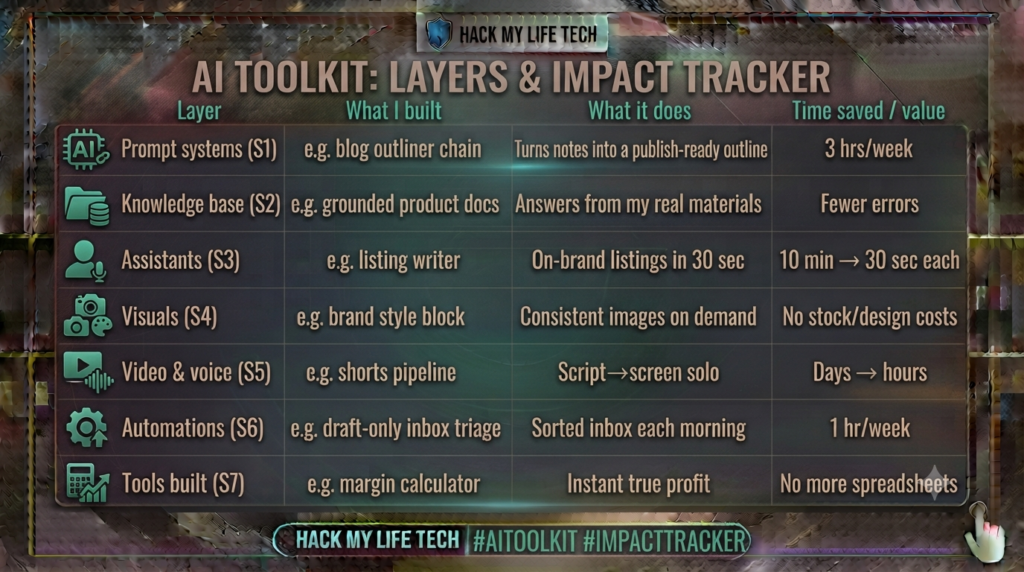
Two rules that make this powerful: quantify everything (hours, error rates, costs avoided — vague claims persuade nobody), and keep artifacts (screenshots, links, before/after outputs). This single page helps distinguish “I use AI” from “here’s what I built with it.”
2. The Four Realistic Income Lanes
These four practical lanes cover common ways people may apply AI skills, but they are not the only possible models. Results depend on existing expertise, demand, distribution, pricing, costs and consistency. Treat any income timeline as an estimate, never a promise.
🟢 Lane 1 — Do your current work better (often the simplest starting point)
The most underrated lane, because it needs no clients, no audience, and no new business. Use your stack to deliver more, faster, with fewer errors in the job you already have — then make it visible: bring your documented stack to your review, propose the automation your team needs, become the person who ships.
Possible outcomes include better performance, stronger evidence during a review, or new internal opportunities. The risk may be lower than starting freelance work because you are applying the method within an existing role, but employer policies and accuracy still matter.
🔵 Lane 2 — AI-augmented freelance services
Sell outcomes, not “AI services.” Nobody buys “prompt engineering”; people buy a month of on-brand social content, a cleaned-up product catalog, an automated inbox workflow. A well-documented workflow may help you complete some tasks more efficiently, but the time saved depends on the scope, quality checks and client requirements.
Start where you have domain knowledge — Practical knowledge of a specific industry can make a narrowly scoped offer more credible than a generic “AI consultant” claim.
A first client may take weeks or months—or longer—depending on your network, offer, market and consistency.
🟡 Lane 3 — Digital products
Templates, prompt packs, mini-tools (Step 7), courses, notion systems. A digital product can be sold more than once, but it still requires distribution, maintenance and customer support. Higher leverage, slower start: expect to build an audience or a distribution channel first, because products without distribution simply don’t sell.
The timeline varies widely, and many first products earn little until the creator finds a suitable audience and distribution channel.
🟠 Lane 4 — Content & audience
Blog, YouTube, newsletter — monetized via ads, affiliates, or your own products. The slowest and least certain lane, and the one with the highest ceiling. It compounds only with consistency.
Income from content is highly variable and may take months or longer; some projects never become profitable.
⚠️ A practical expectation is that Lanes 1 and 2 may produce feedback or income sooner because they connect directly to an existing employer or client problem. Lanes 3 and 4 usually require distribution, iteration and patience. No lane guarantees income, and any unpaid period should be treated as a cost that you can afford.
3. Pricing, Ethics & Disclosure
Four principles that keep the money clean:
- Use transparent pricing and scope. Hourly, fixed-fee, milestone, and value-based pricing each have trade-offs. Define revisions, licences, taxes, deliverables, and exclusions in writing, and do not claim savings that have not been measured.
- Disclose appropriately, and check the rules that apply to your work. Under Article 50 of the EU AI Act, certain transparency obligations for providers and deployers of AI systems apply from 2 August 2026. These include marking or labelling requirements for certain AI-generated or manipulated content, including deepfakes. The exact duties depend on the system, content and role involved, so creators should check the current official guidance before publishing or selling synthetic media. For client work, agree upfront how AI is used and whether disclosure is required.
- Never sell unverified output. Every claim, number, and citation you deliver is yours — Essentials Step 7’s rule is now a business liability, not just a habit.
- Protect client data. Don’t paste confidential material into consumer tools without permission, and apply Step 6’s least-privilege rule to any automation touching a client’s accounts.
4. Staying Current Without Drowning
The field moves monthly; your attention doesn’t have to. A sustainable system:
- Follow release notes, not hype. The official changelogs of the two or three tools you actually use beat any influencer feed.
- Run a quarterly bake-off. Re-run Essentials Step 5’s test on your own real tasks. Your workflow, not a leaderboard, decides what’s best.
- One experiment a month. Try exactly one new tool or technique per month, with a real task. Adopt it only if it beats what you have.
- Re-read your own stack page quarterly. Prune what you stopped using; add what you built. The document is a living asset.
🙋 5. Common Beginner Questions: Three Practical Income Scenarios
Q1 — Scenario: a parent exploring flexible work: “What income range is realistic, and how can I avoid side-hustle scams?”
Answer: Honestly: nothing for the first while, results may remain zero, become irregular, or grow depending on demand, execution, costs, and distribution — and anyone giving you a confident dollar figure for a stranger’s first month is selling a course, not describing reality. A more defensible approach is to expect uncertainty and test demand before committing significant time or money.
Lane 2 (services) may provide faster market feedback for people who already understand a client problem, but it does not guarantee earlier payment. Start with a problem you already understand, such as a listings workflow, a content batch or a set-up automation. Choose one paid outcome, price it modestly for an initial test, and document what the client received. Start with one paid outcome — a month of listings, a content batch, a set-up automation — with a written scope and a price that covers expected work and costs. Request only genuine, voluntary testimonials and never make them a condition of undisclosed compensation.
Lane 3 (digital products) may offer scheduling flexibility, but it still needs distribution first, so avoid attaching a universal timeline to it. The scam tells are consistent: guaranteed income figures, “passive” anything, urgency, and courses that teach you to sell the same course.
Real skill sells outcomes to people with problems. A course is not a substitute for evidence; the next useful step is to test one small outcome with a real user or customer.
Before paying for a programme or accepting an offer, compare its claims with the warning signs in Scamwatch’s guidance on jobs and side-hustle scams.
Q2 — Scenario: an office worker improving their current role: “Can AI help my career without starting a side hustle?”
Answer: This is Lane 1, and it can be a practical starting point for someone who wants to improve their current role without immediately finding freelance clients.
The move is to make invisible efficiency visible: bring your Section 1 stack page to your next review with quantified numbers (for example, a clearly labelled hypothetical claim such as “a weekly report workflow reduced measured preparation time after review”), because “I use AI” is a shrug while “measured preparation time changed from X to Y over Z reviewed trials” is a promotion case.
Then expand scope deliberately: build the shared team assistant from Step 3, propose the draft-only automation from Step 6, and become the person who ships improvements rather than asking for them.
Two cautions: check your employer’s AI policy before connecting company data to anything, and never let AI-assisted output go out unverified under your name. This combination may strengthen your case, but the outcome depends on your role, employer policy and the quality of the evidence you present.
Q3 — Scenario: a recent graduate building portfolio evidence: “How can I show my abilities without formal work history?”
Answer: Build evidence, not credentials — and your Section 1 stack page is the start, not the finish.
The strongest portfolio for someone with no work history is three shipped artifacts with a story attached: a working tool from Step 7 (link it, live), an automation you built and can screenshot with before/after time savings, and a small body of AI-assisted creative work from Steps 4–5. For each, write four lines — the problem, what you built, the result, what broke and how you fixed it — because that last line signals judgment, which is the scarce thing employers actually screen for.
Then consider a self-directed or volunteer project only with informed consent, a written scope, appropriate data controls, and no misleading claims about the relationship.
Two positioning notes: pair AI capability with a domain (AI + marketing, AI + logistics) rather than presenting as a generic “AI person,” and be ready to talk about the guardrails from Steps 6 and 7 — a graduate who can explain least privilege, verification habits, and why AI-generated code needs review reads as far more hireable than one who only demos outputs.
📊 6. Your First 30 Days
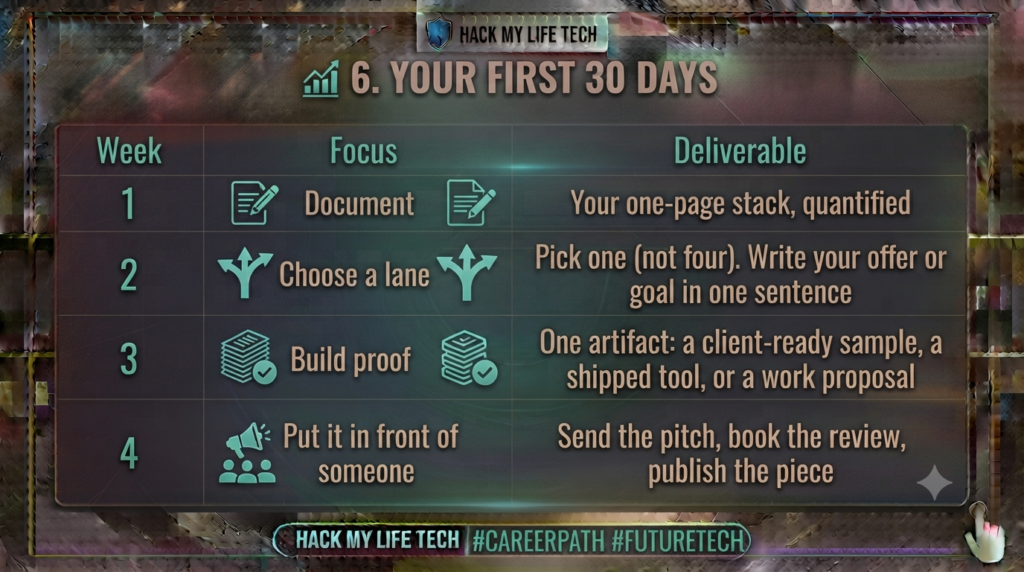
One lane, one artifact, one conversation. That’s the entire first month.
A practical first month can be structured as follows:
Week 1 — Choose one income lane and record a baseline: task time, current cost, audience or potential customer.
Week 2 — Build one small asset from Steps 1–7, such as a service sample, automation demo, digital template or content prototype.
Week 3 — Test the asset, check privacy and commercial-use terms, document what failed, and calculate the time and direct costs involved.
Week 4 — Publish one clearly scoped offer or asset and start one honest conversation with a potential customer, employer or audience.
Track gross revenue, direct costs, subscriptions, taxes and net profit separately. A sale is revenue, not automatically profit. Keep appropriate records and check the rules in your country. Australian readers can consult the official business record-keeping guidance from business.gov.au.
📝 7. Series Finale: Look How Far You’ve Come
Level 1 (AI Essentials) taught you what AI is, how it learns and predicts, which tool to use, how to prompt, and how to verify. Level 2 (AI Deep Dive) turned that understanding into production:
- Step 1: context engineering — prompt systems, not prompts.
- Step 2: RAG and your own data — grounded answers.
- Step 3: custom assistants — configure, test, and maintain.
- Step 4: image generation — art-direct your visuals.
- Step 5: video and voice — a one-person studio, labeled honestly.
- Step 6: agents and automation — delegate with guardrails.
- Step 7: vibe coding — ship real software.
- Step 8 (today): your stack, your lane, your first 30 days.
Here’s the thread running through all fifteen lessons: AI is leverage, and you are the judgment. The tools got extraordinarily capable while you were reading this curriculum, and they’ll be more capable next quarter.
What doesn’t change is the part you now own — knowing what to build, what to verify, what to delegate, and what to keep firmly in human hands.
You may have started Level 1 wondering whether AI was too complicated to understand. You’re finishing Level 2 with a clearer framework for building, testing and reviewing assistants, automations, media and software.
Now go make something — carefully, honestly, and with your name proudly on it.
⏮️ Previous Lesson: [Deep Dive Step 7] Vibe Coding: Build Your First Real Tool with AI
🎓 You’ve completed the AI Deep Dive. Revisit any lesson from The AI Deep Dive Curriculum Roadmap, or start at the beginning with The AI Essentials Curriculum.
Income and business disclaimer
This lesson provides educational examples, not an income forecast or personalised financial, tax, employment, or legal advice. Earnings may be zero and costs may exceed revenue. Validate demand with a small reversible test, keep records, disclose AI use where required, and consult qualified professionals for obligations in your location.