
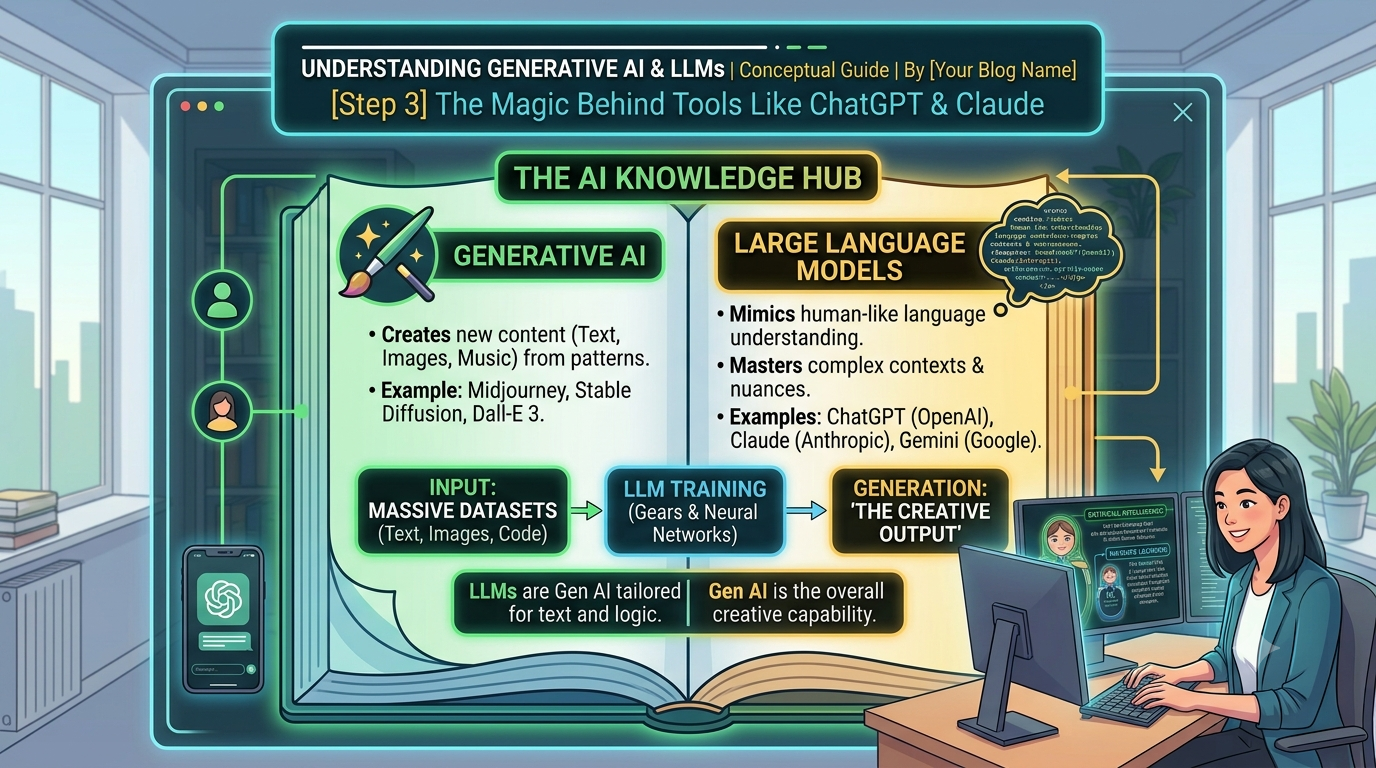
Welcome back to the AI Essentials series! In our last lesson, we stacked the Matryoshka dolls: AI is the broad field, machine learning learns patterns from data, and deep learning is machine learning with deep neural networks. Generative AI describes systems that produce content; it is not the outermost layer of that hierarchy.
We also ended with a cliffhanger: how did we jump from AI that recognizes blurry cat photos to tools like ChatGPT and Claude that write poetry, summarize contracts, and translate emails in seconds?
The answer fits in a single sentence — and by the end of this lesson, you will genuinely understand it:
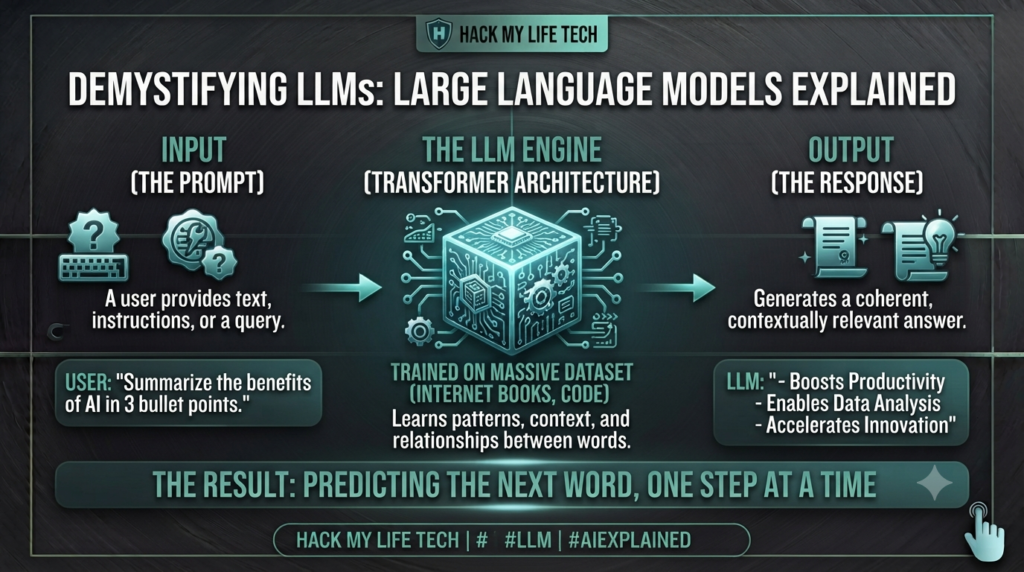
💡 Modern chatbots and LLMs are “next-token prediction machines” — roughly, systems that predict what text should come next.
No math degree required. Let’s open the box.
1. The Art Critic vs. The Artist: The Two Families of AI
A useful teaching contrast is prediction or classification versus content generation. Real recommendation and recognition products can combine several kinds of models, so their interface alone does not reveal their architecture.
💡 The Museum Analogy:
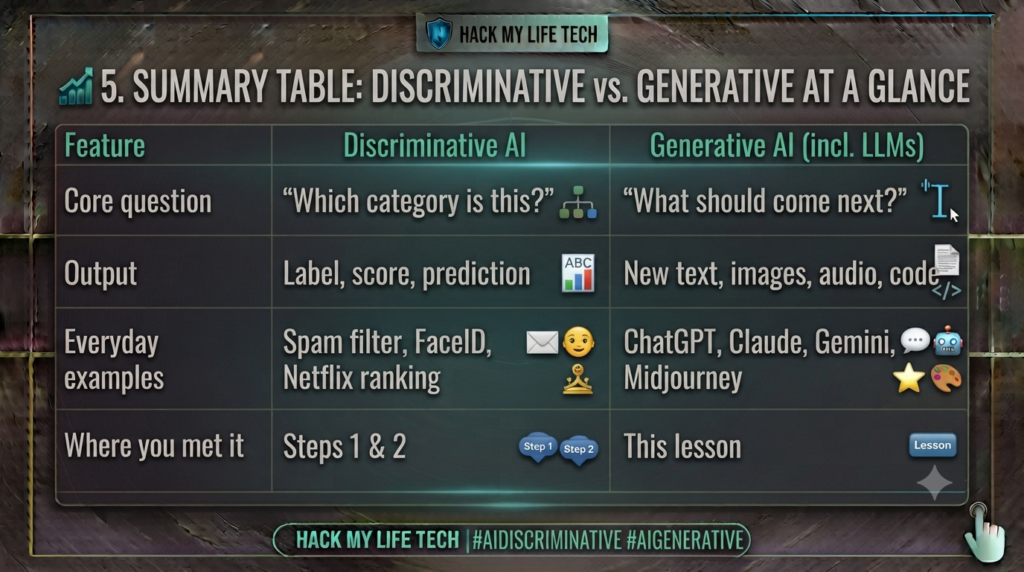
- Discriminative AI (The Art Critic): You show it a painting and it hands down a judgment. “This is a cat, not a dog.” “This email is spam.” “This transaction looks fraudulent.” Its job is to draw a line between categories and tell you which side your input falls on.
- Generative AI (The Creator): You provide a request and the system generates text, images, audio, or code from learned patterns. The output may be novel in arrangement, but novelty is not guaranteed and results can resemble training material or existing works, so copyright and originality still require review.
Look at the output to understand the task: a label or score suggests prediction, while a paragraph or picture suggests generation. This is a task-level shortcut, not a reliable test of the underlying model: a generative model can also output a label.
Generative AI isn’t brand new, either. In 2014, a research team led by Ian Goodfellow proposed a famous setup in which two neural networks compete — one acting as a forger creating fake images, the other as a detective catching fakes — until the forger becomes shockingly good.
That idea helped popularise neural generative modelling. However, many current image-generation systems, including modern tools such as DALL·E and Midjourney, use different architectures and should not be described as direct GAN descendants.
- Source: Goodfellow, I., et al. (2014). Generative Adversarial Nets. Advances in Neural Information Processing Systems (NeurIPS).
- Why it matters: It proved neural networks could create convincing new data — not just classify existing data.
But the generative technology that actually changed daily life for most of us works with words. Enter the LLM.
2. What Exactly Is a Large Language Model (LLM)?
Let’s decode the name piece by piece — because for once, the jargon is completely honest:
- Large: Trained on a staggering amount of text (a meaningful slice of the public internet, books, and articles) by tuning billions of internal dials called parameters.
- Language: Language modelling concerns sequences of tokens. Text-only models read and generate text; multimodal systems can also process or generate other media.
- Model: The exact same idea from Step 2 — a mathematical pattern-finding machine built with deep learning.
And here is the core intuition of this entire lesson:
💡 At its heart, an LLM is a next-token prediction engine. A token may be a whole word, part of a word, punctuation mark, or a short character sequence. You already own a tiny one. When your phone keyboard suggests “you” after you type “thank,” that is next-word prediction.
An LLM uses the portion of the conversation and instructions available inside its current context window. It processes that context with a neural network trained on large datasets, but it may forget, truncate, misread, or inconsistently use earlier details.
Given “The cat sat on the ___,” it predicts “mat.” Given your half-written email plus the instruction “make this polite,” it predicts — word by word — what a polite version of that email would look like. This describes the text-generation step. A complete assistant may also retrieve documents, run tools or process other media.
(Exactly how it picks each word using tokens and probabilities is the star of Step 4 — today we stay at the intuition level.)
📜 Landmark Research 1: The Transformer (2017)
Before Transformers became influential in 2017, recurrent and convolutional approaches already handled translation and sequences, but long-range dependencies, parallel training, and scaling remained difficult. Transformers improved attention-based processing and parallelisation; they did not make long documents or faithful generation automatically solved.
Then a team of Google researchers published a paper with a rockstar title: “Attention Is All You Need.” It introduced the Transformer, an architecture built around a mechanism called self-attention — the ability to look at all the words at once and learn which words matter most to each other.
Take the sentence: “The robot picked up the ball because it was light.” What does “it” refer to? Attention lets the model represent relationships between “it,” “ball,” and “light”, though this mechanism does not guarantee a correct interpretation — exactly the kind of judgment that translation and summarization live or die on.
- Source:Vaswani, A., et al. (2017). Attention Is All You Need Advances in Neural Information Processing Systems (NeurIPS).
- Why it matters: Virtually every major modern language model is built on this architecture. In fact, the “T” in ChatGPT stands for Transformer.
📜 Landmark Research 2: The Scale Surprise (2020)
The second breakthrough was less an invention and more a discovery: when you make these models drastically bigger, they don’t just get slightly better — they gain abilities nobody explicitly programmed.
In 2020, OpenAI trained GPT-3 with 175 billion parameters and reported something remarkable: without any task-specific retraining, the model could translate, answer questions, and even attempt arithmetic just by being shown a few examples inside the prompt — a behavior the researchers called few-shot learning.
- Source: Brown, T. B., et al. (2020). Language Models are Few-Shot Learners. Advances in Neural Information Processing Systems (NeurIPS).
- Why it matters: It revealed why “just predicting the next word” is deceptively powerful. To predict text well across science papers, recipes, legal contracts, and jokes, a model is forced to internalize grammar, facts, writing styles — and even the step-by-step reasoning patterns hidden inside human writing.
3. Why One Trick Unlocks Writing, Summarizing, AND Translating
Here is the beautiful part. Creation, summarization, and translation feel like three different superpowers — but to a next-word predictor, they are the same job wearing three different uniforms:
- The model learned statistical patterns from its training process and can imitate many formats, but coverage is incomplete and provenance varies. A generated introduction can be useful as a draft, not proof of originality, accuracy, or permission to reuse protected material.
- Summarization: The internet is packed with long-text → short-text pairs: abstracts, TL;DRs, headlines, executive summaries. So when the model sees your three-page report followed by “Summary:”, the model may generate a summary-like continuation. It can still omit or invent details, so compare the result with the source.
- Translation: Decades of parallel text (the same content in multiple languages) taught it that the words most likely to follow a Korean sentence plus “In English:” are… the English equivalent.
Think of a person who has read deeply their whole life. Without taking a single extra class, they can usually write well, summarize well, and “translate” expert-speak into plain language. Massive reading, one skill, many jobs. That is an LLM.
🙋 4. Reader Q&A: Three People, Three Very Different Questions
(Representative questions beginners commonly ask — answered without the jargon.)
Q1 — from an 11-year-old learning to code: “So ChatGPT is just my phone’s autocomplete but bigger? Autocomplete is dumb though. It always suggests the wrong word in my game chats.”
Answer: Your instinct is exactly right — they are the same species, but a completely different league. Your keyboard’s autocomplete mostly remembers which word tends to follow the last one or two words: a player who memorized the answers.
An LLM plays “guess the next word” while using the conversation content available in its current context — characters, rules, tone — like a player who actually followed the story. Try this experiment: start a story about a dragon named Kevin who is afraid of birthday cakes, write three sentences, and ask a chatbot to continue it.
A capable assistant may reuse the detail while it remains available in the current context, whereas a basic keyboard autocomplete normally relies on a much shorter local context. Memory features vary by product and settings and should not be assumed.
Q2 — from an AI-major university student: “If it’s only predicting the next word, where does the apparent reasoning come from? Is there a hidden logic module?”
In a base language model, there is no guaranteed general-purpose logic engine. Models can display reasoning-like performance through learned patterns, context, training, tools, and inference methods, but performance varies and can fail even when an explanation sounds convincing. Few-shot results such as Brown et al. (2020) are historical evidence from particular models and evaluations, not proof of human-like reasoning.
To accurately predict the next token in text that contains worked math solutions, code, and structured arguments, the network is pressured to approximate the procedures that produced them. On top of the base model, labs add fine-tuning stages (instruction tuning and human feedback) that shape how it responds — we will dissect that pipeline in Step 4.
And keep your healthy skepticism: how deep this “understanding” really goes remains an active research debate, and prediction can be confidently wrong — which is exactly why Step 7 of this series is dedicated entirely to hallucinations.
Q3 — from an office worker who wants to leave on time: “Fine, it predicts words. What do I actually hand over to it tomorrow morning?”
Answer: Start with every task that begins with a blank page or a wall of text — that is LLM home turf:
- First drafts: emails, reports, announcements (“Draft a polite reminder to the vendor about the overdue invoice.”)
- Meeting notes → action items: paste the messy notes and ask for a five-bullet summary with owners and deadlines.
- Tone surgery: “Rewrite this to be firm but friendly.”
- Brainstorm buffet: “Give me 10 subject lines for this newsletter,” then keep the best two.
One golden rule: AI drafts, you decide. You remain editor-in-chief — especially for names, numbers, and facts. (Why fact-checking is non-negotiable is the entire story of Step 7.)
5. Summary Table
⚡ 6. Try It Today: The 5-Minute Desk Test
Open an approved chatbot and run the drill with a public-domain passage or a short fictional example. Do not paste real email threads, meeting notes, personal information, confidential material, or copyrighted content unless your organisation and the service explicitly permit that use.
- Privacy first: Before pasting anything, remove names, email addresses, phone numbers, passwords, account details, client information, and confidential business content. Use anonymised text and review the chatbot’s data and privacy settings.
- Paste the text and ask: “Summarize this in 3 bullet points and list any action items with deadlines.”
- Then ask: “Draft a reply in a friendly but professional tone, under 120 words.”
Total time: about five minutes. What you are watching is next-word prediction performing summarization and creation back-to-back — the exact theory from this lesson, running live on your own work.
📝 7. Recap & What’s Next?
Today, you cracked the core vocabulary of the generative age:
- Prediction and generation describe different tasks. Output helps identify the task but does not prove the model architecture.
- An LLM is a next-token prediction engine. A token may be a whole word, part of a word, punctuation mark, or a short character sequence.
- One skill, many jobs: prediction at scale is why the very same tool can draft, summarize, and translate.
But this raises the question that keeps beginners up at night: if it is all prediction, is the AI actually thinking — or just rolling very sophisticated dice? And why does it sometimes state complete nonsense with total confidence? In the next lesson, we open the hood and follow a single sentence through the machine, token by token.
⏮️ Previous Lesson: [Step 2] AI vs. Machine Learning vs. Deep Learning Explained
⏭️ Next Lesson: [Step 4] How Do AI Models Work? The Science Behind the Answers