
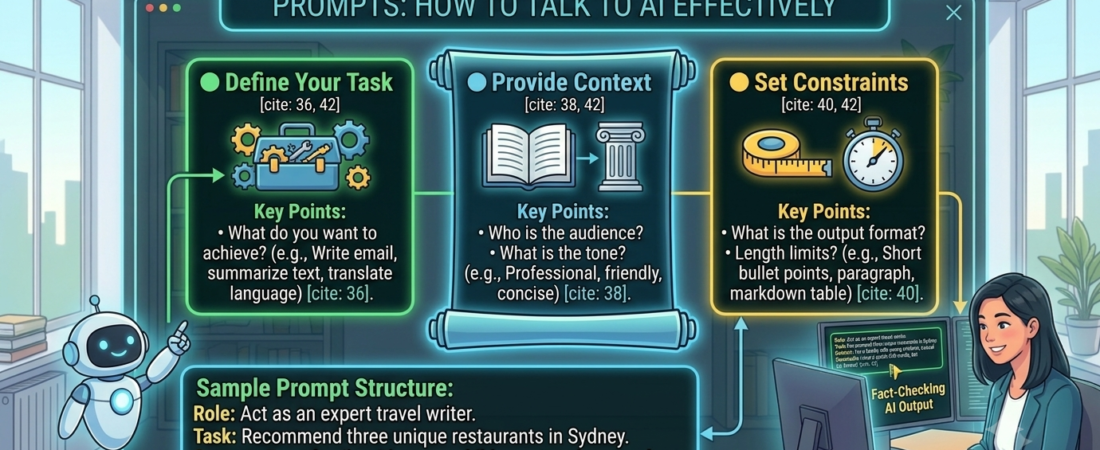
Welcome back to the AI Essentials series! Last lesson ended with a twist: in test after test, the gap between a lazy prompt and a skilled prompt is bigger than the gap between ChatGPT, Claude, and Gemini. You’ve chosen your car. Today, you learn to drive.
Here is the one sentence this entire lesson hangs on:
💡 A prompt is not a search query, and it is not a wish. It is a briefing. Brief the AI the way you’d brief a smart new intern on their first day, and the quality of every answer changes — on any tool, permanently.
By the end of this lesson you’ll have the five-part briefing formula the roadmap promised (Role, Context, Task, Format, Examples), a before/after demonstration you can feel, the science of why it works, and copy-paste templates for reports, study notes, trip planning, and resumes.
1. Why Prompts Change Everything (The Science in 60 Seconds)
Remember Step 4? A chatbot computes the most plausible continuation of the text you gave it. That single fact explains all of prompting:
- Give it a vague prompt — “write something about marketing” — and there are a million plausible continuations. The model averages across all of them and hands you the statistical middle: technically correct, personality-free, useful to no one. I call this the beige answer.
- Give it a specific prompt — audience, goal, constraints, format — and you collapse that million-continuation cloud into a narrow target. The same engine now produces something sharp.
Here’s the reframe that changes how you’ll use AI forever: most “bad AI answers” are under-specified questions. The model wasn’t lazy. The briefing was.
Think of the world’s fastest intern: brilliant, tireless, read most of the internet — and knows nothing about you, your project, or what “good” looks like to you until you say it. Nobody hands an intern a sticky note reading “make report better” and expects brilliance. Yet that’s how most people prompt.
2. The Briefing Formula: R-C-T-F-E
Five parts. Memory hook: “Real Chefs Taste Food Early.”
- R — Role: Who should the AI be? — “You are a senior recruiter who has screened over a thousand resumes.” A role sets the expertise lens, vocabulary, and tone before a single answer-word is predicted.
- C — Context: What’s the background? — the situation, the audience, the constraints. “I’m a retail manager with 8 years of experience switching into data analysis.” Context is the ingredient people skip most — and the one that kills the beige answer fastest.
- T — Task: What exactly should it do? — one clear action verb plus a deliverable: “Rewrite these three bullet points.” This is the only truly mandatory element; everything else amplifies it.
- F — Format: What should the output look like? — structure, length, tone: “Three bullets, each under 20 words, each starting with a strong verb.”
- E — Examples: What does good look like? — paste one sample. This is the scientifically heaviest hitter: showing examples inside the prompt is exactly the “few-shot learning” that stunned researchers in the GPT-3 paper we met in Step 3.
- Source: Brown, T. B., et al. (2020). Language Models are Few-Shot Learners. Advances in Neural Information Processing Systems (NeurIPS).
- Why it matters: It proved models can learn a task from examples inside the prompt itself — no retraining needed. When you paste a sample of “what good looks like,” you are using a documented scientific capability, not a folk trick.
3. Before & After: Watch the Same Request Transform
Let’s run the roadmap’s resume scenario, because everyone has felt this pain.
❌ Before (the sticky note):
“Make my resume better.”
Typical result: ten generic tips (“use action verbs!”, “quantify achievements!”) you’ve read a hundred times. Beige.
✅ After (the briefing):
[Role] You are a senior recruiter who has screened 1,000+ resumes for career-switchers moving from retail into tech. [Context] I’m a retail store manager with 8 years of experience applying for entry-level data analyst roles. My current bullets sound purely operational. [Task] Rewrite my three experience bullets below to highlight transferable analytical skills. My bullets: (1) managed daily store operations, (2) handled inventory, (3) trained new staff. [Format] Return exactly 3 bullets, each under 20 words, each starting with a strong verb, each including one plausible metric placeholder I can fill in. [Example] Style sample: “Reduced inventory shrinkage 12% by building a weekly Excel tracking system across 3 stores.”
Now the output comes back in your situation, your format, recruiter-grade. Same tool. Same $20. Different driver.
One reassurance: the labels are training wheels. Once the five questions live in your head, the same briefing works written as one natural paragraph — the structure matters, not the brackets.
📜 4. The Magic Phrase That Turned Out to Be Real
Prompting attracts folklore — but one “magic phrase” survived scientific scrutiny spectacularly. In 2022, researchers found that showing models worked, step-by-step reasoning examples made them dramatically better at logic and math problems — a technique called chain-of-thought prompting. A second team then discovered something almost comical: simply appending the words “Let’s think step by step” — with no examples at all — unlocked much of the same effect. In one arithmetic benchmark, a model’s accuracy leapt from roughly 18% to 79% on the strength of that single sentence.
- Source 1: Wei, J., et al. (2022). Chain-of-Thought Prompting Elicits Reasoning in Large Language Models. Advances in Neural Information Processing Systems (NeurIPS).
- Source 2: Kojima, T., et al. (2022). Large Language Models are Zero-Shot Reasoners. Advances in Neural Information Processing Systems (NeurIPS).
- Why it matters: Together, these papers proved prompting is a measurable science, not superstition — the words you choose can unlock capability that was inside the model all along.
Why does it work? Step 4 again: text that walks through reasoning statistically continues into correct conclusions more often than text that blurts an answer. You’re steering the prediction path.
A 2026 honesty note: many modern models now offer “thinking” or “reasoning” modes that do this internally, so the literal phrase matters less on those. But the underlying principle — break complex requests into steps, and ask to see the reasoning on high-stakes problems — still pays on every model, every year.
5. Two Power Moves the Formula Doesn’t Mention
Power move 1 — The Interview Reversal. The single highest-leverage sentence in prompting, especially when you’re not sure what context matters:
“Before answering, ask me up to 5 questions that would help you do this perfectly.”
You’ve just made the AI write its own briefing. It will ask about audience, tone, constraints — the exact R-C-T-F-E you didn’t feel like typing. Answer its questions, and the final output quality jumps. This is the lazy person’s route to expert prompts, and it is completely legitimate.
Power move 2 — Iterate like a director, not a gambler. The first answer is a first draft, not a verdict. Weak prompters hit regenerate and hope (slot machine). Strong prompters steer: “shorter.” “More formal.” “Give me 3 alternative openings.” “Now as a table.” Each follow-up inherits all your earlier context — the conversation itself becomes the briefing. If you find yourself giving the same corrections repeatedly, promote them into your opening prompt next time. Congratulations: you’re now writing templates.
🙋 6. Reader Q&A: Three People, Three Very Different Questions
(Real questions our readers keep sending in — answered without the jargon.)
Q1 — from a stay-at-home parent running a resale side hustle: “Five elements, every single time? I’m listing thirty items a week. I don’t have time to write essays to a robot.”
Answer: You don’t — and the formula never asked you to. Two shortcuts. Shortcut 1: the minimum viable prompt is Task + Format. “Write a marketplace listing for this jacket. Format: title under 60 characters, 3 selling-point bullets, friendly tone.” That’s it — add Role/Context/Examples only when the stakes rise. Shortcut 2: write the briefing once, reuse it forever. Build one great listing prompt (use the Interview Reversal to help), save it in your notes app, and from then on you only swap the item details — thirty seconds per listing. Recurring task → template. One-off important task → full R-C-T-F-E. Quick throwaway question → just ask. Matching effort to stakes is the skill.
Q2 — from an 11-year-old who wants cheat codes: “Are there magic words for AI? Like actual spells? My friend says if you’re mean to it, it works harder.”
Answer: Here’s the truth, detective. AI is less like a wizard and more like a genie — it grants the literal wish, not the wish in your heart. Say “tell me a story” and you get a random beige story. Say “tell me a 5-sentence bedtime story about a dragon named Kevin who’s scared of birthday cakes, with a funny ending” and you get exactly the gold you imagined. (Yes — Kevin from Step 3 is back. Legends return.) The spell isn’t a secret word; it’s detail. As for your friend: being mean doesn’t reliably help, and there WAS one real magic phrase scientists proved — “Let’s think step by step” (Section 4). It made AI way better at math. That’s a cooler cheat code than being rude, and you can cite an actual research paper on the playground.
Q3 — from an AI-major university student: “Role prompting feels like astrology to me. ‘You are a world-class economist’ can’t add knowledge the weights don’t contain. Is there a real mechanism, or is this cargo cult?”
Answer: Healthy skepticism — here’s the mechanism, straight from Step 4. A role line doesn’t add parameters; it conditions the distribution. Every token you provide shifts the probability landscape for every token that follows, and “You are a senior economist writing for policymakers” moves probability mass toward the vocabulary, structure, hedging style, and depth found in expert-adjacent text in the training data — measurably different continuations than a bare question produces. What it cannot do is conjure knowledge or credentials that aren’t in the weights: a role makes outputs more expert-shaped, which is exactly why Step 7’s verification habits matter more, not less. Your instinct to sort evidence from folklore is right, though — chain-of-thought and few-shot examples have strong peer-reviewed support (Wei 2022; Brown 2020), while tricks like tipping promises or threats show inconsistent, anecdotal results. When in doubt, run the Step 5 bake-off on the technique itself: same task, with and without, ten trials. Now you’re doing prompt science instead of prompt astrology.
📊 7. Cheat Sheet: The Formula at a Glance
| Element | The question it answers | Example line |
|---|---|---|
| Role | Who should the AI be? | “You are a senior recruiter with 10 years in tech hiring.” |
| Context | What’s the background? | “I’m switching careers from retail; applying to entry-level analyst roles.” |
| Task | What exactly should it do? | “Rewrite my 3 experience bullets to highlight analytical skills.” |
| Format | What should the output look like? | “3 bullets, under 20 words each, strong verbs, one metric each.” |
| Examples | What does good look like? | “Style sample: ‘Reduced shrinkage 12% via weekly Excel tracking.’” |
Grab-and-go templates (swap the [brackets], keep the bones):
- Work report: “You are a [role]. Context: [project, audience, deadline]. Summarize the notes below into a report for [audience]. Format: [length, sections, tone]. Notes: […]”
- Study notes: “You are a patient tutor. I’m studying [topic] for [exam/level]; I struggle with [weak point]. Turn the material below into [flashcards / a 10-question quiz / a one-page summary]. Format: [structure].”
- Trip planning: “You are a local travel planner. Context: [dates, city, budget, party, interests, pace]. Build a [N]-day itinerary. Format: day-by-day table with morning/afternoon/evening and one backup rainy-day option.”
- Resume polish: the full briefing from Section 3 — it’s already a template.
⚡ 8. Try It Today: The 5-Minute Before/After Test
The roadmap promised you’d feel the difference firsthand. Here’s the experiment:
- Pick one real task from your week (an email, a study summary, a listing).
- Send the lazy version — one sentence, the way you’d have asked yesterday.
- Open a fresh chat and send the briefing version — R-C-T-F-E, or just use the Interview Reversal and answer its questions.
- Put the two outputs side by side. The gap you’re looking at is not a better AI. It’s a better you.
Bonus round: run the briefing version on two different tools — Step 5’s bake-off and Step 6’s formula are better together.
📝 9. Recap & What’s Next?
Today you learned to drive:
- A prompt is a briefing, not a wish — vague briefings produce beige answers by mathematical necessity.
- The formula: Role, Context, Task, Format, Examples — Real Chefs Taste Food Early.
- Scale the effort to the stakes: Task + Format is the everyday minimum; the Interview Reversal writes the briefing for you; templates make excellence reusable.
- “Let’s think step by step” was real, peer-reviewed magic — structure complex requests into steps.
- Iterate like a director — the conversation is the prompt.
But here is the uncomfortable truth that even a perfect briefing cannot fix: sometimes the AI answers your beautifully-crafted prompt with total confidence — and it’s completely wrong. Why does a machine this capable invent facts, fake citations, and imaginary court cases? Remember Step 4’s dice? In our final lesson, everything in this series converges: why hallucinations happen, how to catch them before they cost you, and the ethics and safety habits that separate a responsible power user from a headline waiting to happen.
⏮️ Previous Lesson: [Step 5] ChatGPT vs. Claude vs. Gemini: Which AI Should You Use?
⏭️ Next Lesson: [Step 7] AI Hallucination and Ethics: What Every Beginner Must Know