
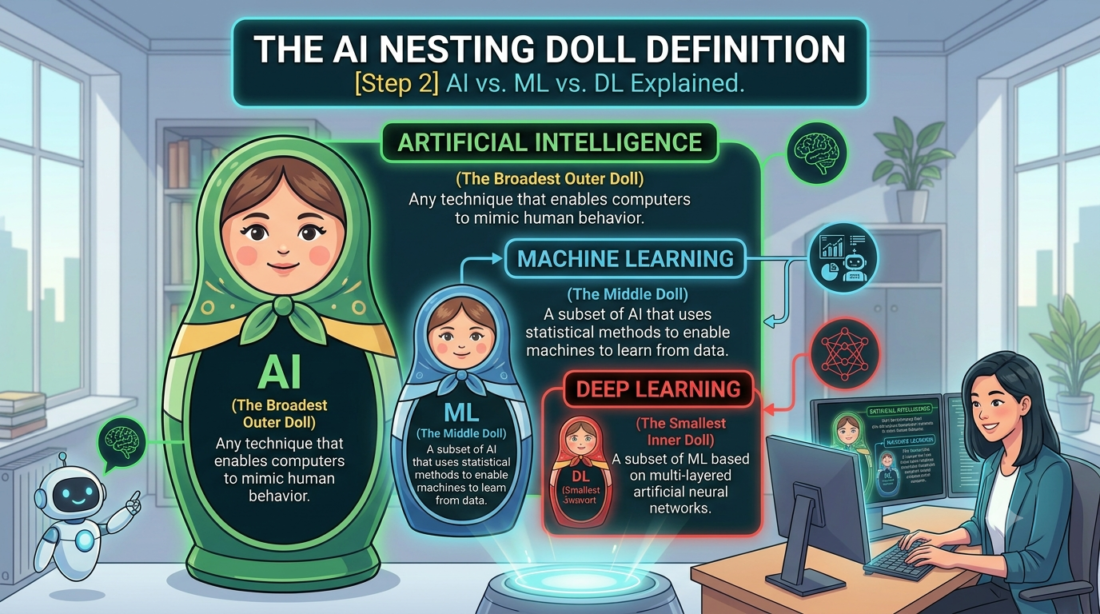
Welcome back to the AI Essentials series! In our last lesson, we stripped away the sci-fi panic and learned exactly what artificial intelligence is (and how it secretly runs apps like Spotify and Google Maps every single day).
But as you start reading more about technology, you will constantly bump into three terms used almost interchangeably: artificial intelligence (AI), machine learning (ML), and deep learning (DL).
If you are a non-technical creator, business owner, or student, this can feel like a massive wall of jargon. You might find yourself asking, “Are they all the same thing? Do I need a math degree to get this?”
The answer is No. And here is the one sentence this entire lesson hangs on:
💡 AI, machine learning, and deep learning are not three competing technologies — they are three nesting dolls, one inside the other. Once you see the dolls, you can never unsee them.
Today, we break down these buzzwords with simple real-world analogies, look at the landmark research that made the tech possible, and — as a bonus — hand you a 3-question detector that exposes when a product slaps “AI-powered” on the box without any real AI inside. No math degree required.
1. The Russian Matryoshka Doll Analogy
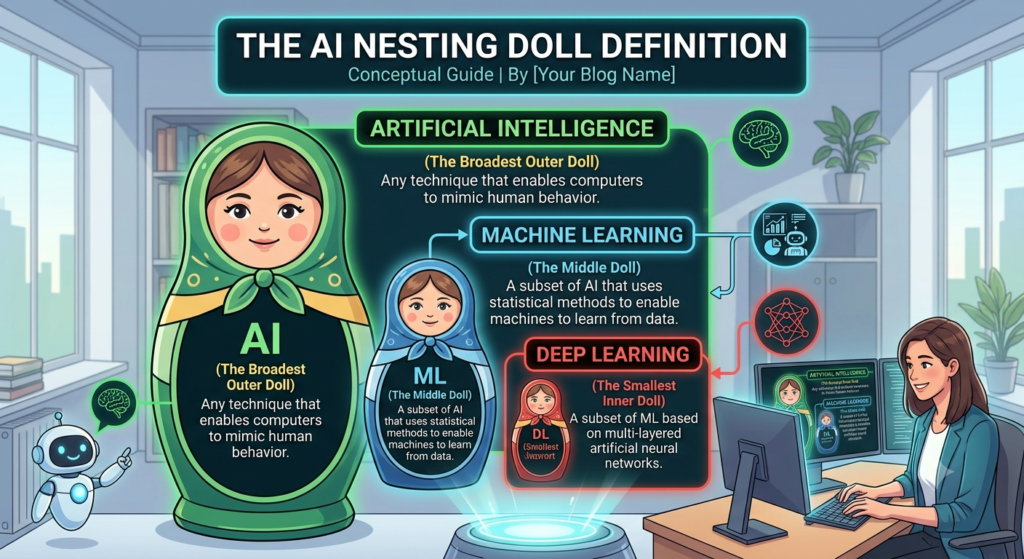
The easiest way to understand the relationship between AI, machine learning, and deep learning is to picture a set of Russian nesting dolls (Matryoshka dolls). They are not rivals; they are layers nested inside one another.
💡 Image created by AI for AI Essentials Curriculum learning visualization purposes.
- Artificial Intelligence (AI) is the widest, overarching doll. It represents the grand goal: making machines smart.
- Machine Learning (ML) is a specific method we use to achieve AI. Instead of hand-coding every rule, we give the computer data and let it learn.
- Deep Learning (DL) is a highly advanced, specialized technique within machine learning. It uses artificial structures that mimic the human brain to process incredibly complex data.
And underneath all three dolls sits the fundamental dividing line of this whole lesson — the one the tech industry is built on:
Hand-written rules and learned patterns can both appear in AI. Machine learning specifically learns from data; rule-based AI need not. A trained model can then make predictions without updating its parameters during each use. See IBM Research’s training/inference explanation.
2. Jargon-Free Breakdowns: One Business Problem, Three Layers
Let’s watch each layer handle the same practical business example: predicting real estate / housing prices.
🟢 Layer 1: Machine Learning (ML) – The Smart Pattern Finder
In traditional programming, you would write an explicit rule: If a house has 3 bedrooms, price = $500,000. But the real world is messy.
Hypothetical example: Suppose a dataset contains past property attributes and sale prices. A regression model can estimate relationships from that data rather than relying only on a hand-written price rule. The quality of the estimate depends on the data, features, sampling, market changes, and evaluation; this example is not a report of a real Sydney dataset or test result.
- Real-World Tool: Spam filters & fraud detection. Your bank uses ML to flag a transaction when you suddenly buy a luxury watch overseas even though you usually only buy groceries locally.
- The Science Connection: The foundations of data-driven learning were famously advanced by Arthur Samuel in 1959, when he proved a computer could teach itself to play checkers better than the human who programmed it — and gave the field its name.
- Source: Samuel, A. L. (1959). Some Studies in Machine Learning Using the Game of Checkers. IBM Journal of Research and Development.
- Why it matters: It was the first celebrated proof that a machine could outgrow its own creator’s instructions by learning from experience.
🔵 Layer 2: Deep Learning (DL) – The Virtual Brain
Now, what if the data isn’t neat numbers in a spreadsheet? What if you want a system that can look at a smartphone photograph of a house and instantly estimate its value from the architectural style, the color of the paint, and the quality of the roof?
A spreadsheet can contain images, but image recognition requires a method for processing their visual information. Deep learning uses multiple layers of mathematical units to learn representations. It is one approach to visual data, and it also works with other data types; an image input alone does not prove that deep learning is used.
- Real-World Tool: Midjourney, ChatGPT, and FaceID. When your phone unlocks by looking at your face, a deep learning network is digesting the complex, unstructured visual data of your features.
- The Science Connection (a 26-year bet): In 1986, Geoffrey Hinton and colleagues popularized backpropagation — the training algorithm that finally let multi-layered networks learn from their mistakes. For decades the approach was dismissed as a dead end. Then, at the 2012 ImageNet challenge, Hinton’s team unleashed a deep network that achieved a major improvement in ImageNet classification, and the modern AI boom began. Same scientist, same idea, 26 years apart.
- Source 1: Rumelhart, D. E., Hinton, G. E., & Williams, R. J. (1986). Learning Representations by Back-Propagating Errors. Nature.
- Source 2: Krizhevsky, A., Sutskever, I., & Hinton, G. E. (2012). ImageNet Classification with Deep Convolutional Neural Networks. Advances in Neural Information Processing Systems (NeurIPS).
- Why it matters: Together, these two papers are the “before and after” of the deep learning revolution — the method (1986) and the moment it conquered the world (2012).
3. The Buzzword Detector: 3 Questions That Expose Fake “AI”
Here is the superpower this lesson promised. Marketers know “AI-powered” sells, so the label gets stapled onto everything from toothbrushes to rice cookers. These three questions reveal what’s actually inside the box:
- “Was a model trained on data, and how is it updated?” Many deployed models remain fixed between training runs. Consistent behaviour during use does not distinguish a learned model from hand-written rules; ask for the documented training and evaluation process.
- A credible ML product should provide appropriate information about data provenance, evaluation, limitations, privacy, and governance, although security or licensing constraints may limit what can be disclosed publicly. Treat vague marketing claims as a reason to request evidence, not automatic proof of fraud.
- “Could a simple rulebook do this?” A thermostat that turns on at 7 a.m. follows a rule, not a model. Rule-based automation is perfectly useful software — it just isn’t learning, and you shouldn’t pay an “AI premium” for it.
Verifying deep-learning claims: Images, audio, and free text are often handled with neural networks, but other statistical and rule-based methods can also process engineered features from unstructured data. Ask the vendor for model documentation, evaluation results, limitations, and the role of human review instead of inferring the architecture from the input alone.
Use this checklist next time you shop for “smart” gadgets or sit in a meeting where someone announces an “AI initiative.” You will be the person in the room who can tell the layers apart.
🙋 4. Reader Q&A: Three People, Three Very Different Questions
Representative beginner questions, presented for this lesson.
Q1 — from a solo startup founder who watches every dollar: “If deep learning is so powerful, why don’t we just use it for everything?”
Answer: Because deep learning is incredibly “expensive” — not just in money, but in data and computing power.
- Data hunger: The amount of data depends on the task, model, and whether an existing model is being reused. Traditional machine-learning models can work well with smaller, structured datasets, while deep-learning models trained from scratch often need much more data. However, transfer learning and pre-trained models can make deep learning practical with far fewer task-specific examples.
- Computing power: Training large networks can require substantial hardware, while small or pretrained networks may run on ordinary devices. Compare measured accuracy, latency and cost for the actual task instead of assuming one model family is always cheaper.
The practical rule of thumb is to start with the simplest approach that meets the measured requirement. Use deep learning when the data, task, and evaluation justify the added complexity, infrastructure, cost, and risk—not merely because the input is an image, audio, or text.
Q2 — from an 11-year-old learning to code: “What is a ‘neural network’ in plain English? Is there a literal tiny brain inside my computer?”
Answer: No biological parts, promise! Think of a neural network as a massive game of “Pass the Guess.” Imagine 30 kids in rows trying to identify a blurry drawing of a cat:
- The first row only looks at basic shapes — lines and edges — and whispers what they see to the next row.
- The middle row combines those clues (loops, triangles) and realizes, “Hey, those look like pointy cat ears.”
- The final row looks at the big picture and shouts, “It’s a cat!”
In a computer, the “kids” are tiny mathematical equations organized into layers. The deeper the rows go, the more complex the ideas they can recognize — and when the network guesses wrong, that backpropagation trick from 1986 taps every row on the shoulder and says, “adjust your whisper slightly.” Play enough rounds, and the whole line gets scarily good at the game.
Q3 — from a first-year teacher building an AI unit: “My students keep calling everything ‘AI.’ How do I teach this hierarchy in one classroom activity, without slides full of definitions?”
Answer: Run the Nesting Circle Sorting Game — it takes 15 minutes and one whiteboard. Draw three concentric circles labeled AI → ML → DL, then hand out cards with familiar examples: calculator app, spam filter, face unlock, chess program with hand-coded moves, Netflix recommendations, ChatGPT, a thermostat timer.
Teams defend each placement with evidence: was the system trained on data, and does its documented model use a deep neural network? If the architecture is unknown, mark it unknown. Images, audio and text alone do not establish the innermost circle.
The debates are where the learning happens: the thermostat card outside all circles and the chess card in the outer AI ring spark the exact “hand-written vs. discovered rules” insight this lesson is built on. Close by having each team write a one-line definition of their trickiest card. You’ll cover the whole hierarchy without lecturing a single slide.
📊 5. Summary Table: Quick Reference Guide
| Feature | Artificial Intelligence (AI) | Machine Learning (ML) | Deep Learning (DL) |
|---|---|---|---|
| What is it? | The grand vision / concept | The data-driven method | The advanced neural technique |
| Data required | Can be zero (rule-based) | Task- and method-dependent | Often large and task-dependent; smaller datasets may work with transfer learning, pretrained models, augmentation, or narrow tasks |
| How it learns | Programmed or learned | Statistical pattern-finding | Deep artificial neural networks |
| Example | Chess computer (Deep Blue) | Predicting prices from a spreadsheet | Generating an image of an astronaut |
⚡ 6. Try It Today: The 5-Minute Nesting-Doll Audit
Reading about dolls is one thing; spotting them in the wild is the skill. Two quick drills:
- Audit your phone: Pick three features you used today and assign each a layer. Maps predicting your commute time from traffic data? Machine learning. Face unlock reading your features? Deep learning. The calculator? Plain old hand-written rules — and proud of it.
- Stress-test one ad: Ask what the system does, what evidence supports its claims and what limitations are documented. Missing information is a reason to ask questions, not proof that no AI is used.
Five minutes, and the jargon wall becomes a glass wall.
📝 7. Recap & What’s Next?
Now you can confidently navigate tech conversations! Today you locked in four ideas:
- AI is the umbrella goal — the outermost doll.
- Machine learning learns patterns from data; that data can take many forms.
- Deep learning is machine learning using deep neural networks. The layers are mathematical operations, not biological brains.
- The detector: Does it improve with data? What was it trained on? Could a rulebook do it? — three questions that separate real AI from marketing costumes.
Speaking of raw human language… how did we get from recognizing blurry cats to tools like ChatGPT that can write poetry, code apps, and debate philosophy? In our next lesson, we explore the exact bridge that made it possible: Generative AI and LLMs.
⏮️ Previous Lesson: [Step 1] What is AI? A Beginner’s Guide
⏭️ Next Lesson: [Step 3] Understanding Generative AI and Large Language Models (LLMs) Explained