
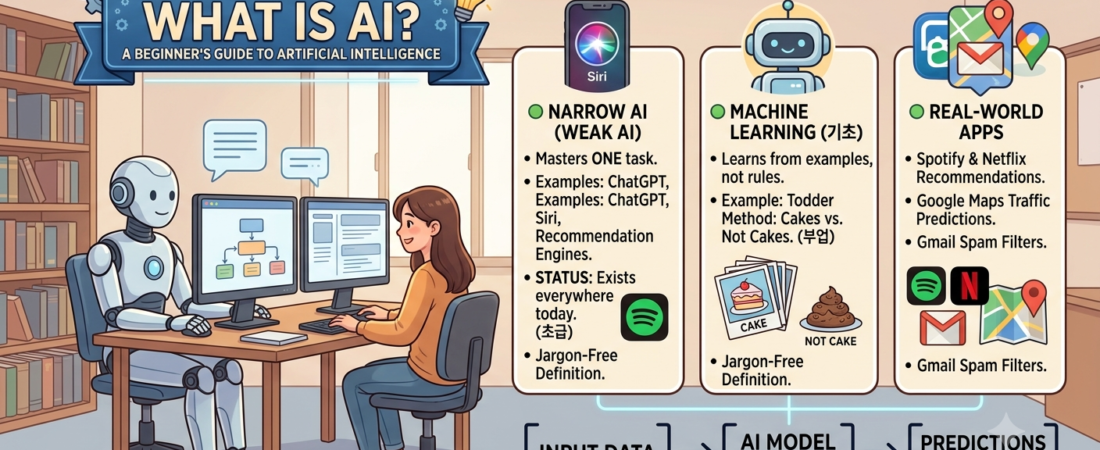
Welcome to your first step [ what is AI ] in learning artificial intelligence. If you read the news today, AI is this overnight miracle that came out of nowhere. But behind the shiny tools like ChatGPT is a history of mathematics, engineering, and data science that stretches back decades.
As a university student here in Australia walking through the digital space, I used to think AI was just pure science fiction — something for tech giants and software engineers. The reality? Your superpower is knowing how AI works… because AI is already running your world.
And here is the one sentence this entire series is built on:
💡 AI is not a robot, and it is not magic. It is software that finds patterns in data — and then uses those patterns to judge, predict, and create. You have probably used it twenty times today without noticing once.
In this guide, we’ll explain what AI really is, strip away the complicated tech-speak, see how it works with real-life examples, ground our understanding in the core academic studies — and end with a 60-second experiment that lets you watch AI work on your own phone.
1. What Exactly Is Artificial Intelligence? (The Human Analogy)
At its simplest, artificial intelligence (AI) is a branch of computer science dedicated to creating systems capable of performing tasks that would typically require human intelligence. This includes things like learning, reasoning, problem-solving, understanding language, and recognizing visual patterns.
A useful way to hold all of that in one hand: modern AI systems do three kinds of work —
- Judge: “Is this email spam or not? Is this a photo of a cat or a dog?”
- Predict: “What song will this person want next? When will this car arrive?”
- Create: “Write a paragraph. Draw an astronaut. Compose a melody.”
Keep those three verbs in your pocket; every tool you meet in this series is doing one of them. (Steps 3 and 4 will show you exactly how.)
To fully understand AI, it helps to compare how computers traditionally worked with how AI works:
💡 The Traditional Coding vs. AI Analogy:
- Traditional Coding (The Baking Recipe): Imagine giving a computer a strict recipe. “Take 4 eggs, 400g of flour, mix for 5 minutes, and bake at 160°C.” The computer follows this exactly. If you give it a completely different ingredient, it crashes because it wasn’t programmed for it.
- Artificial Intelligence (The Toddler Method): Instead of a recipe, you show the computer 10,000 photos of different cakes and 10,000 photos of things that are not cakes (like shoes or cars). Over time, the computer figures out the underlying pattern of what makes a cake a cake. You didn’t give it rules; it figured out the rules by itself.
This shift from giving strict rules to letting the machine learn from examples is what we call “machine learning,” which forms the backbone of modern AI.
One more myth to bust before we go further: AI is not a robot. A robot is a body — metal, motors, sensors. AI is a mind — pure software. Some robots carry AI inside them, but the overwhelming majority of the world’s AI has no body at all: it lives quietly in server farms and smartphones, sorting your photos and filtering your inbox. When the news shows a humanoid robot every time it says “AI,” it is showing you the rare container, not the technology.
2. A Brief Grounding in Science: Where Did This All Start?
AI isn’t a 2020s invention. The theoretical groundwork was laid down in the mid-20th century. When writing about AI, it’s incredibly important to ground our knowledge in the foundational academic papers that started it all.
📜 Landmark Research 1: The Turing Test (1950)
The question “Can machines think?” was famously formalized by British mathematician Alan Turing. In his seminal paper, he introduced the “Imitation Game” (now known as the Turing Test), which proposed that if a machine could converse with a human and pass as human, it could be considered “intelligent.”
- Source: Turing, A. M. (1950). Computing Machinery and Intelligence. Mind, 59(236), 433–460.
- Why it matters: It shifted the debate from philosophical definitions of “consciousness” to practical, measurable behaviors. (Hold onto that idea — it comes back in the Q&A below, when a young reader asks whether Siri has feelings.)
📜 Landmark Research 2: The Dartmouth Workshop (1956)
The actual term “artificial intelligence” wasn’t coined until 1956, during a summer research project at Dartmouth College organized by John McCarthy, Marvin Minsky, and other legendary scientists. They asserted that every aspect of learning or intelligence can, in principle, be so precisely described that a machine can be made to simulate it.
- Source: McCarthy, J., Minsky, M. L., Rochester, N., & Shannon, C. E. (1955). A Proposal for the Dartmouth Summer Research Project on Artificial Intelligence.
- Why it matters: This officially launched AI as an independent academic discipline.
❄️ And Then… Two Winters
Here is the part the “overnight miracle” headlines skip: between those optimistic beginnings and today’s boom, the field froze over — twice. In periods researchers now call the “AI winters,” hype outran the era’s puny computers and scarce data, funding collapsed, and “AI” became almost a dirty word in labs. What ended the ice age wasn’t one genius idea but three slow tides rising together: vastly more data (the internet), vastly cheaper computing power (gaming graphics chips, of all things), and better learning algorithms. In Step 2, you’ll meet a scientist who kept working straight through the frost for 26 years — and then changed everything.
The takeaway for a beginner: today’s AI is not a bubble that appeared from nowhere. It is a 70-year-old science that finally got the fuel it was waiting for.
3. How AI Works in Your Everyday Life (Hidden Examples)
You don’t need to open an AI app to interact with artificial intelligence. You are likely interacting with it dozens of times a day without even realizing it. Let’s look at four everyday systems driven by AI:
📱 Example 1: Spotify and Netflix Recommendation Engines
When Spotify curates your “Discover Weekly” playlist, or Netflix suggests a new show, an AI algorithm is working behind the scenes.
- How it works: It uses a method called “collaborative filtering.” The AI analyzes your past behavior (songs you skipped, shows you watched until midnight) and matches your mathematical profile with millions of other users. If User A and User B love the same 90 songs, and User A suddenly listens to a new 91st song, the AI automatically recommends that 91st song to User B.
- Which verb? Predict.
🚗 Example 2: Google Maps Traffic Predictions
When you type a destination into Google Maps and it accurately predicts that you will arrive at exactly 5:42 PM despite heavy traffic, that is AI in action.
- How it works: Google Maps analyzes historical traffic patterns, live location data from thousands of smartphones currently on that road, and even historical weather data to simulate potential delays and optimize your route in real time.
- Which verb? Predict.
📧 Example 3: Gmail Spam Filters
Ever wonder how your email inbox magically filters out fraudulent crypto schemes or fake lottery wins?
- How it works: Early spam filters looked for specific keywords like “FREE MONEY.” Spammers got smart and started writing it as “F.R.E.E M.O.N.E.Y.” Modern AI filters use Natural Language Processing (NLP) to look at the semantic meaning, the sender’s reputation, and the metadata structure of the email to flag spam — even if it uses completely new phrasing.
- Which verb? Judge.
📸 Example 4: Your Photo App’s Face and Object Sorting
Open your phone’s photo gallery and notice how it has quietly grouped pictures by person — your mum’s album, your best friend’s album — without you tagging anyone. Or type “dog” or “beach” into the photo search bar and watch it find them.
- How it works: A computer-vision model converts each photo into a mathematical fingerprint of visual features, clusters similar faces together, and labels recognizable objects and scenes. It learned what “dog-ness” looks like from millions of example images — the Toddler Method from Section 1, running silently in your pocket.
- Which verb? Judge. (And when the same app suggests an auto-edited “Memories” video? That’s create sneaking in.)
Notice something? You didn’t install a single “AI app” — yet AI touched your music, your commute, your inbox, and your photo album before lunch.
4. The Two Types of AI: Narrow vs. General
To prevent yourself from falling for sci-fi panic (like AI taking over the world tomorrow), you need to understand the fundamental distinction between the AI we have today and the AI we might have in the future.
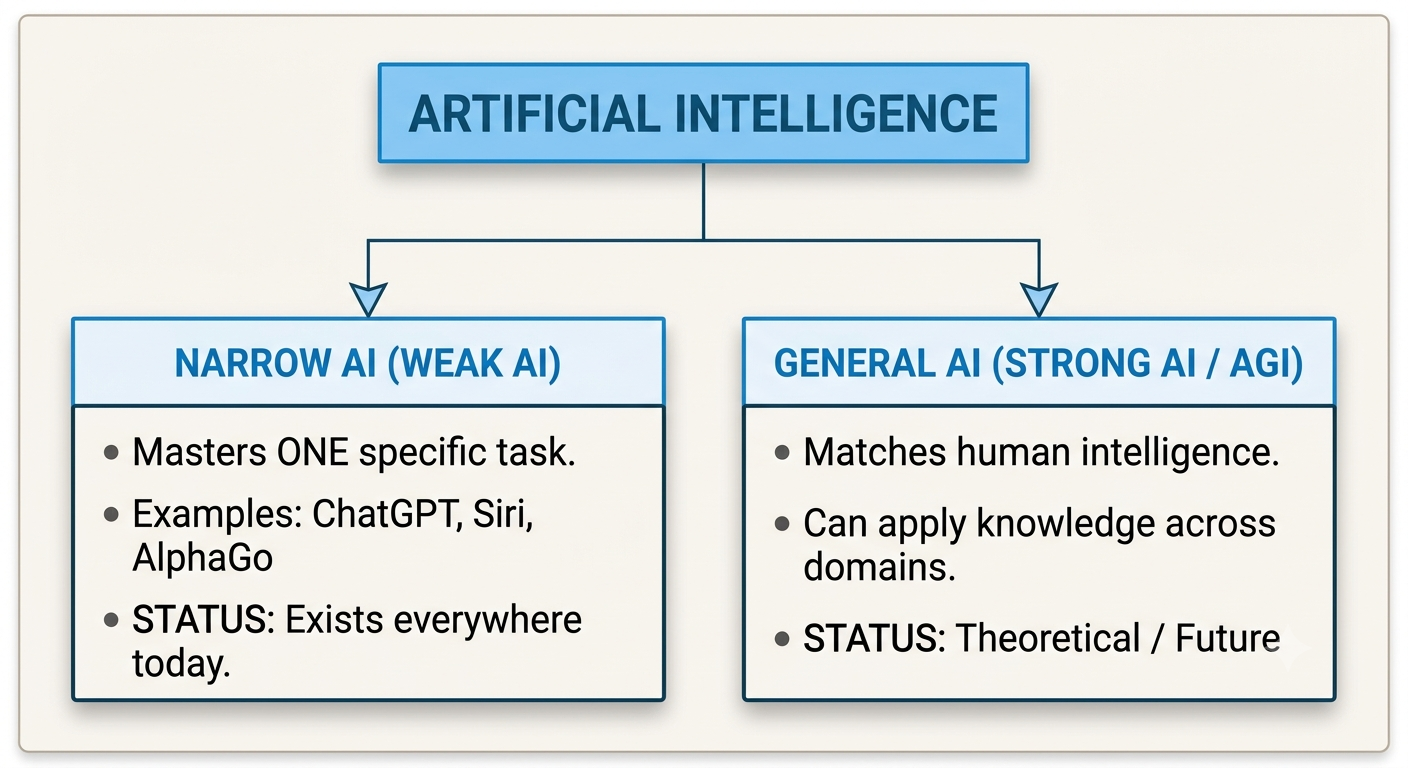
- Artificial Narrow Intelligence (ANI / Weak AI): This is the AI we live with today. It is programmed to do one specific thing incredibly well — often better than humans — but it fails completely at anything else. For example, an AI that can diagnose skin cancer from medical images cannot play a simple game of chess. ChatGPT is an advanced form of narrow AI; it is an expert at predicting text, but it cannot genuinely experience emotion or solve physical real-world problems.
- Artificial General Intelligence (AGI / Strong AI): This is the holy grail of sci-fi. AGI refers to a machine that possesses the ability to understand, learn, and apply knowledge across a wide variety of tasks at a human level. It could write a novel, fix a car, learn an instrument, and study philosophy seamlessly. True AGI does not exist yet.
📊 Summary Table: Narrow AI vs. General AI
| Feature | Narrow AI (ANI) — what exists | General AI (AGI) — what doesn’t |
|---|---|---|
| What it is | A specialist: one task, superhuman focus | A generalist: human-level flexibility across any task |
| Examples | Spam filters, FaceID, Google Maps, ChatGPT | Sci-fi characters (JARVIS, Samantha from Her) |
| Status today | Everywhere — in your pocket right now | Does not exist; timeline hotly debated |
| Sci-fi panic level | Misplaced — it can’t want anything | Premature — worth discussing, not fearing daily |
🙋 5. Reader Q&A: Three People, Three Very Different Questions
(Real questions our readers keep sending in — answered without the jargon.)
Q1 — from a stay-at-home parent with no tech background: “I barely survived setting up the family printer. Can someone like me really learn AI — or is it too late and too technical for me?”
Answer: Not only can you learn it — you are the exact person modern AI was redesigned for. Here’s the shift most people missed: for seventy years, using computers meant learning their language (code). Generative AI flipped the direction — the machine finally learned yours. If you can write a text message, you already have the only technical skill today’s AI tools require. There is no installation marathon, no syntax to memorize, no exam. And you’re not “late,” either: these tools only became usable by the general public very recently, so the head start you imagine everyone else having is mostly a few months of tinkering. This curriculum assumes zero background on purpose — follow it step by step, and by Step 6 you will be giving instructions to AI more skillfully than most office workers. The printer, unfortunately, remains unsolved by science.
Q2 — from an office worker who saw another scary headline: “Honestly, the only question I care about: is AI going to take my job?”
Answer: The honest answer has three layers. First, what today’s AI actually is: narrow intelligence (Section 4). It automates specific tasks — drafting a first version, sorting a mountain of email, summarizing a report — not the judgment, relationships, and accountability wrapped around those tasks. Nobody’s job description is “predict the next word.” Second, what history keeps showing: when spreadsheets arrived, they automated the ledger arithmetic that filled an accountant’s day — and the profession shifted toward analysis and advising rather than vanishing. Tools tend to eat tasks and reshape roles. Third, the part that is worth acting on: the nearer-term gap is opening between people who can direct these tools and people who can’t. The colleague who drafts in minutes what used to take an afternoon changes the standard for everyone. That’s not a reason to panic — it’s a reason to be here. Finishing this series is the insurance policy: by the end, you’ll be the one deciding which of your tasks to hand over, instead of waiting to find out.
Q3 — from a 10-year-old who talks to Siri every day: “When I say ‘Hey Siri,’ does she really understand me? Does Siri have feelings? Sometimes she laughs!”
Answer: Great detective question — and here’s the secret: Siri recognizes, but doesn’t experience. When you speak, your voice becomes a sound wave, the sound wave becomes text, and the text gets pattern-matched against millions of examples until Siri finds “oh, this pattern means play music.” It’s exactly how your photo app finds “dog” pictures (Example 4) without ever knowing what fur feels like, or a dog’s smell, or why dogs are the best. The laugh? A recorded response someone programmed in, chosen when your words match a joke pattern. Remember Alan Turing from Section 2: he taught scientists to ask “does the machine behave intelligently?” instead of “does it feel?” — because behavior is what we can actually test. So: understands your patterns, yes. Has feelings, no. You can still say thank you, though. Good habits are good habits.
⚡ 6. Try It Today: The 60-Second AI Safari
Reading about hidden AI is one thing — catching it in the act is better. Three quick hunts:
- The photo search test (60 seconds): Open your phone’s photo app and search “dog,” “beach,” or “food.” Nobody labeled those pictures. You are watching a vision model judge thousands of images in real time.
- The touchpoint tally (rest of the day): Count every AI encounter before dinner — autocomplete, a recommendation, a spam folder catch, face unlock, a maps ETA. Most people who think they “don’t use AI” hit five before lunch.
- The ad translation drill: Find one product advertised as “AI-powered” and ask: what does it judge, predict, or create? If the ad can’t answer, hold that suspicion — in the next lesson, we’ll sharpen it into a full buzzword detector.
📝 7. Recap & What’s Next?
Today, you learned the following:
- AI isn’t about rigid rules — it’s about machines finding patterns in massive amounts of data, then using them to judge, predict, and create.
- AI is not a robot — it’s software; robots are just one rare container for it.
- AI is grounded in rigorous historical science — from Alan Turing in 1950, through Dartmouth in 1956, and even through two “AI winters” before the current boom.
- You use narrow AI daily — via Spotify, Google Maps, email filters, and the photo app quietly sorting your albums — and narrow AI is a specialist, not a sci-fi overlord.
Now that you understand the absolute basics, you are ready to look under the hood of how these machines actually digest data. In the next lesson, we’ll be breaking down the tech buzzwords people always confuse.
⏮️ Previous Lesson: The AI Essentials Curriculum Roadmap
⏭️ Next Lesson: [Step 2] AI vs. Machine Learning vs. Deep Learning Explained